Vaginal Dilation Routine After Sex Reassignment Surgery
Dr. Chettawut’s Vaginal Dilation Philosophy

Dr. Chettawut’s Vaginal Dilation Philosophy
Over more than two decades performing sex reassignment surgery, I’ve come to see vaginal dilation as a partnership between what I do in the operating room and what you do every day afterward. Neither one works without the other.
I safely create the maximum achievable depth of the vaginal tunnel and use the best quality skin graft to form the entire vaginal lining. This is the foundation — but a foundation only holds if it’s maintained.
Once you leave the operating room, the outcome becomes a shared project. Following the dilation program strictly is how you maintain the depth I created for you.
The stretching force from dilation does two things: it prevents the skin graft from contracting inside the vagina, and it keeps the vaginal wall elastic enough to comfortably accommodate penetration, regardless of size.
Here is the part I want every patient to understand clearly: without adequate, correct dilation, the grafted skin will shrink. And once that shortening happens, it cannot be reversed by dilating more later. The window to preserve your depth is now — not “eventually.”
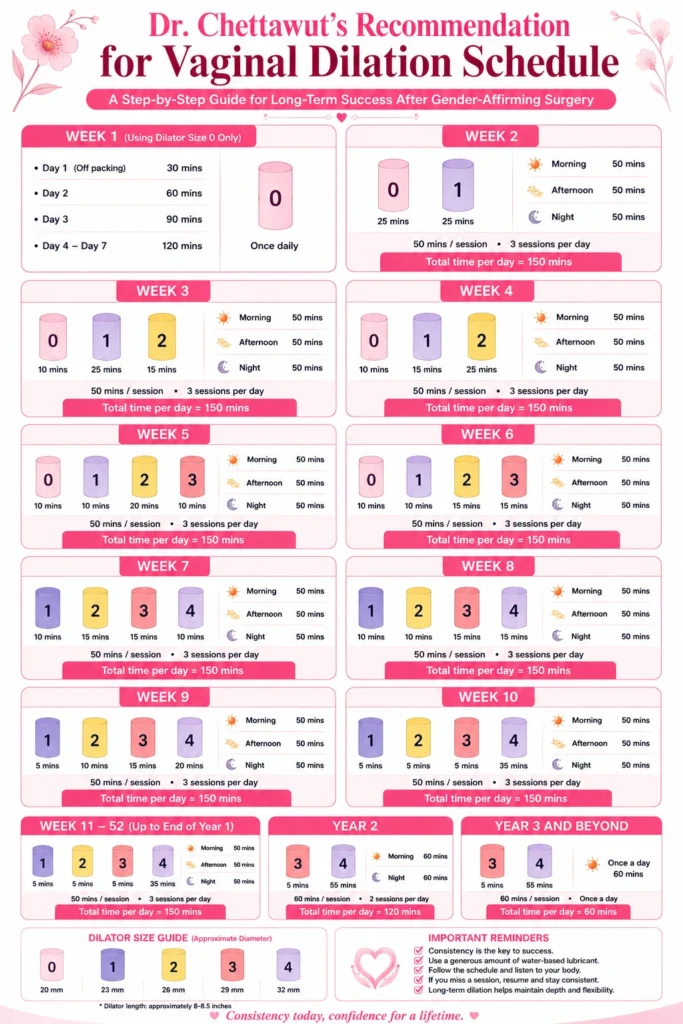
I focus my patients on one number above all: total daily dilation time, which I recommend should be around 2.5 hours per day in the first year. How you split that time across the day matters too, so let me walk you through the two rhythms I offer my patients.
Option 1 — Two sessions of 75 minutes: For most of my patients who work outside the home during the day, two sessions — morning and evening — tend to be the most practical rhythm. The one thing I ask in return is discipline: neither session should ever be missed.
Option 2 — Three sessions of 50 minutes: If you have more flexibility at home during the day, or if you find insertion tight or uncomfortable, I recommend spreading dilation across three sessions instead — morning, afternoon or early evening, and before bed. In my experience and by theory, dilating more frequently throughout the day works better than fewer, longer sessions when tightness is an issue, since it gives the tissue more chances to ease open gradually rather than asking it to stretch hard for one long push, twice a day. Each 50-minute session can also be extended — to 60 or even 70 minutes — if that helps you reach a comfortable depth.
Whichever rhythm you choose, I ask my patients to protect the same total: around 2.5 hours a day in year one.
I provide a full dilator set to every SRS patient of mine — the cost is already included in your surgery package, so there’s no additional expense to worry about while you’re focused on recovery.
My set includes five sizes:
Each dilator is approximately 8.5 inches long.
For patients who progress comfortably past Dilator No. 4 and want to continue building capacity, I now also make an optional Dilator No. 5 available through WIH — you’ll find the details on sizing beyond my original five-dilator set in the complete WIH dilation guide, linked below.
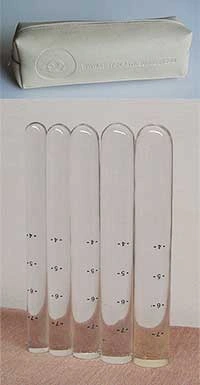
Each dilator is approximately 8.5 inches long.
For patients who progress comfortably past Dilator No. 4 and want to continue building capacity, I now also make an optional Dilator No. 5 available through WIH — you’ll find the details on sizing beyond my original five-dilator set in the complete WIH dilation guide, linked below.
In my SRS technique, I use gauze packing shaped like a tube to stabilize the skin graft inside the vagina for around 7 days. When I gently remove it, I examine the graft with a speculum before your first dilation.
I have my surgical nursing team demonstrate your very first dilation session — that’s also when I confirm your original depth, measured against the scale on the dilator shaft at the vaginal opening. For your first week, I keep dilation under close nursing supervision. I don’t allow patients to dilate unsupervised until my nurses are confident you’ve mastered this delicate technique — it’s too important to rush.
I ask you to wash your hands and your dilator with water and mild soap before and after every session.
I require water-based lubricant — every dilation, every act of intercourse, no exceptions. It’s the single easiest way to prevent tearing the delicate grafted skin. I recommend applying plenty to the tip and shaft of the dilator, and to the vaginal opening itself, before you begin, and reapplying during the session if things feel dry.
I teach my patients to lie on their back in a semi-reclined position, legs bent — the same position as a pelvic exam — then position the lubricated dilator against the vaginal opening, just below the urethral opening.
From there, I ask you to slide the tip in slowly, staying just under the urethra. Gently rotating the dilator in circles can help ease the opening. Push forward at an angle toward your lower back — not straight in — until you reach the full depth of your vagina.
I encourage checking the scale on the dilator often, using your mirror, to confirm you’re reaching bottom — at minimum with your smallest dilator. Once there, hold with gentle, constant pressure. This is what stretches the graft at the deepest point and protects your depth.
One thing I need every patient to hear directly from me: never force the dilator past your existing depth. That’s not how you gain depth —
it’s how you tear the vaginal wall, and that can mean bleeding or, in serious cases, a fistula. I’ve seen depth protected through consistency, never through force.
I tell my patients it’s completely normal to postpone stepping up to a larger dilator if the current size still feels uncomfortable — there’s no fixed deadline I hold you to. And when you do move to a bigger size, I don’t expect it to reach full depth right away; Dilators No. 3 and No. 4 typically need a few sessions of patient, gradual work before they reach bottom. I ask my patients to keep using Dilators No. 1 and No. 2 throughout the first year even after they’ve progressed to No. 3 or No. 4 — rotating through your sizes keeps the whole canal, not just the deepest point, properly maintained.
The philosophy above reflects how I think about dilation and why I designed my program the way I did. For the complete, continuously updated technical guide — including the full week-by-week schedule, dilator progression charts, video demonstrations, and answers to common questions — visit:
(WIH International Hospital’s full clinical reference, covering skin graft, colon, and PPV vaginoplasty techniques.)

Ready to learn more, or need support with your dilation routine? Contact Dr. Chettasak’s team at WIH International Hospital.